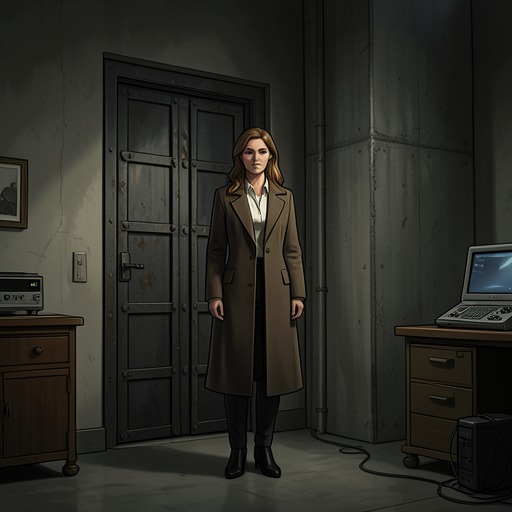
Jonathan Ainsley
A Woman of SubstanceJonathan Ainsley appears in the final family confrontation as one of Emma Harte’s grandsons and a beneficiary of her carefully arranged succession. His part is brief but consequential: Emma’s allocation gives him a stake in Harte Enterprises and a home in New York, while placing him among the younger generation expected to inherit the family’s responsibilities rather than leave its future to the conspirators.
Identity and Introduction
Jonathan is present at Pennistone Royal when Emma gathers her children and grandchildren for what has been presented as a family weekend. The gathering is actually a confrontation she has planned after learning that four of her children are conspiring against her business interests. While the conversation continues, Emma catches Jonathan’s eye and notes that he resembles Arthur Ainsley more than Robin Harte, though she considers his character closer to her own. The comparison is Emma’s private impression; the scene does not further establish Jonathan’s parentage.
When Emma calls the room to order and prepares to read her will, Jonathan responds readily to her request for a glass of water. His quickness to help gives him a small but distinctive role in the staging of the announcement: Emma deliberately takes her time with the papers, and Jonathan’s assistance allows her to sustain the pause before she reveals her decisions.
Place in Emma’s Succession Plan
Emma’s bequests divide her Harte Enterprises shares among four grandchildren. Alexander Barkstone receives 52 per cent; Jonathan, Sarah Lowther, and Emily Barkstone are each allocated 16 per cent. Emma explains that she wants control in one person’s hands to preserve the company and prevent later quarrels, while the other beneficiaries will continue in the subsidiaries and take charge of their own divisions after her death. The plan gives Jonathan both a financial interest and a continuing place in the enterprise, although Emma does not identify a particular division for him.
The provision is backed by a separate one-million-pound trust for each of the four beneficiaries, including Jonathan. Emma presents the arrangements as an attempt to be fair while securing the company’s continuity. The scale and precision of the settlement turn the will into a practical answer to the takeover plot: succession is distributed among selected grandchildren, but central control is deliberately not divided equally.
The Will’s Family Stakes
Jonathan’s inheritance is announced in the same room as the reactions of the older generation. Robin gasps and half rises when Emma reveals the share allocation; Kit is also visibly incredulous. Their response makes clear that Emma’s decision frustrates expectations among the conspirators. Jonathan, by contrast, is one of the named beneficiaries, not one of the four children Emma has identified as plotting against her.
After thanking Emma, Jonathan looks down at his feet rather than meet Robin’s glare. The gesture registers the family pressure attached to the bequest: accepting a place in Emma’s plan also means standing in the wake of his father’s—or, more cautiously, Robin’s—anger and disappointed expectations. Emma’s arrangement makes Jonathan’s inheritance part of a generational transfer, but the scene presents it as a contested choice rather than a simple reward.
Home and Narrative Significance
Emma also leaves Jonathan the Fifth Avenue apartment in New York, together with its furnishings. The residence forms part of a wider distribution of homes and possessions among her grandchildren, complementing the shares and trust with a concrete inheritance. His allotted apartment gives him a defined place in the family’s material future, just as his shareholding connects him to the business.
Jonathan is not developed through an extended independent storyline in these scenes. Instead, his significance emerges through Emma’s assessment of him, his unobtrusive assistance during the reading, and the inheritance that places him among the chosen successors. Against the older children’s conspiracy and anger, he represents one of the younger beneficiaries through whom Emma seeks to preserve the enterprise and forestall another struggle over control.